

Manage payment methods and invoices
Your cards, the address invoices go to, the period in progress, and every invoice already issued.
Billing lives on one page at /{organization}/settings/billing, separate from the rest of Organization Settings. It holds three things: the billing email, which is the address Stripe sends every invoice and every payment failure to; the payment cards on the organization; and the invoices themselves, split across a Current Invoice tab and an Invoices tab.
Before you start. You need to be an Organization Owner. An Administrator is not enough, and neither is anything below it. See Roles and permissions.
Open Billing
- Select your profile picture at the top right of the dashboard.
- Select Billing.
Any role can select the menu item, but only an Owner sees the page. Everyone else gets "You are not authorized to access this page. Only organization owners can access this page."
If that is you, find your Owner. No other role can change a card, an address, or a payment on this account.
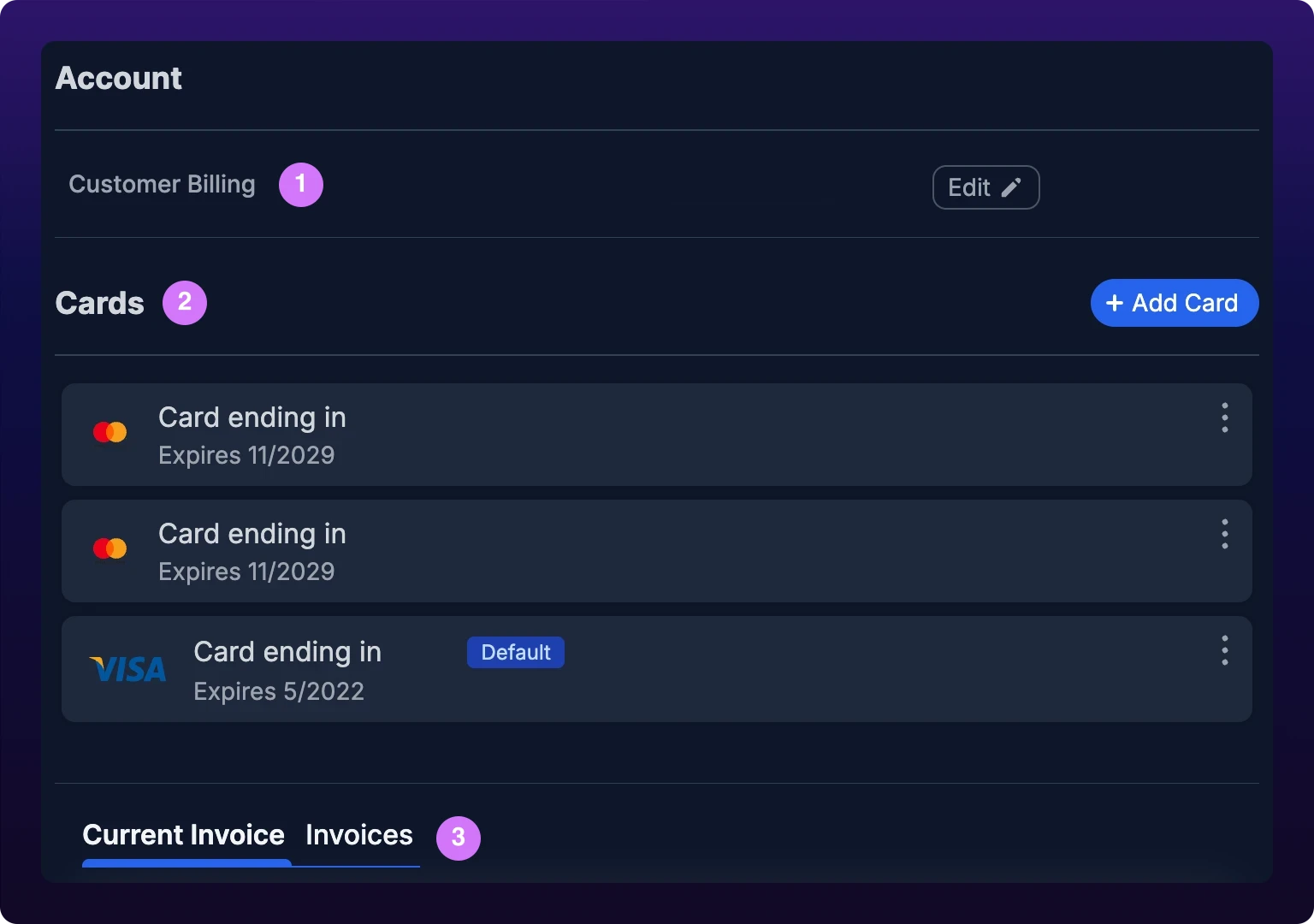
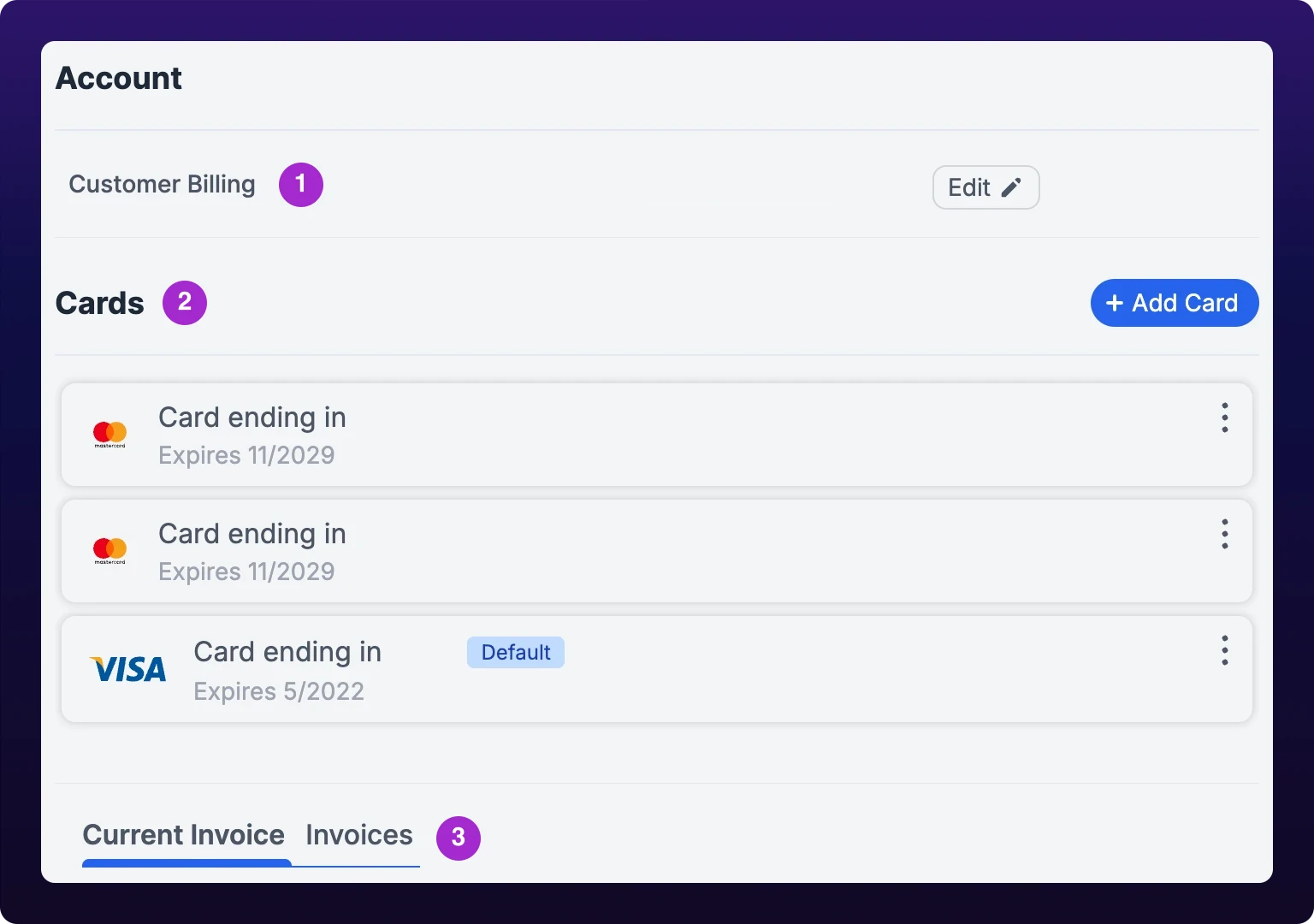 The Billing page at /settings/billing, with the Customer Billing email at the top, the Cards list below it, and the Current Invoice and Invoices tabs at the bottom. Only an Organization Owner can open it.
Set the billing email
The billing email is the Customer Billing field in the Account section at the top of the page. It is the only address Stripe writes to, and it is independent of your own profile email.
- Select Edit beside the field.
- Type the address.
- Select Save.
An "Invoice email updated" toast confirms the change. Cancel discards it.
Use a shared finance address, not a personal one. accounting@midwesttooling.com beats the Owner's own inbox. This address receives payment failures as well as invoices, and a failed payment that sits unread while one person is on vacation is how an organization gets suspended.
Why does an unread invoice matter this much?
An unpaid account is suspended, and a suspended organization stops collecting machine data. The sensors keep running, but nothing is recorded. Paying the bill lifts the lockout and does not backfill the gap, so the hours lost are missing from every report forever.
 The Customer Billing field in edit mode, holding a shared finance address, with Cancel and Save beside it.

Add a card
Cards are handled by Stripe. IoTFlows never sees or stores the number.
- Select Add Card, at the right of the Cards heading.
- Fill in the Add Payment Card dialog: card number, expiry, security code, and the billing details Stripe asks for.
- Select the checkbox agreeing to the IoTFlows Terms of Use. Submit stays disabled until you do.
- Select Submit.
A "Card successfully added!" toast confirms it and the new card appears in the list, showing its brand icon, "Card ending in 4242", and its expiry month and year.
If the card is declined or a field is wrong, Stripe's own message appears under the form. Correct the field it names and submit again. If Stripe accepts the card but IoTFlows cannot save it, you get "Card could not be saved" instead, and no card is added.
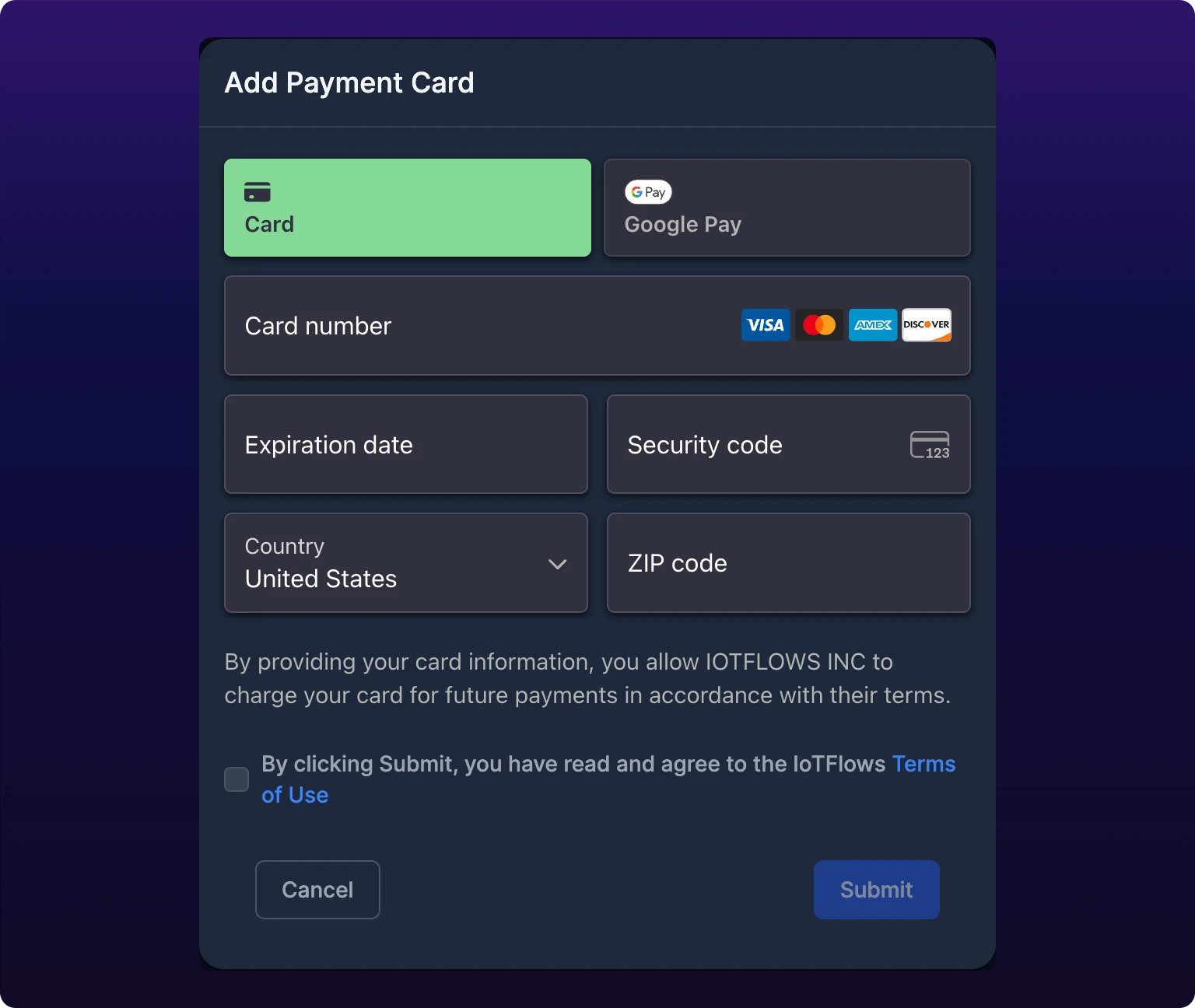
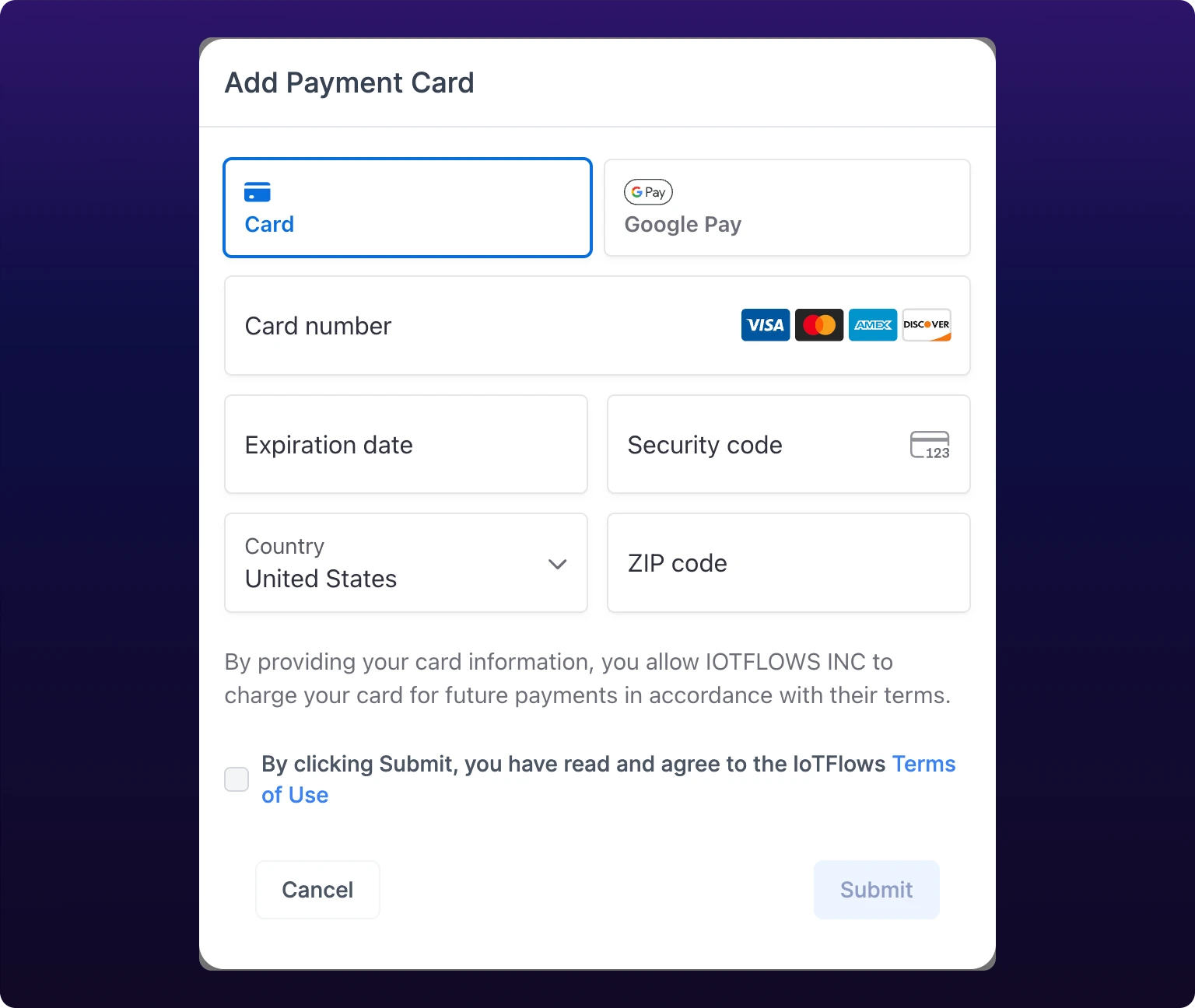 The Add Payment Card dialog, with the Stripe card fields, the Terms of Use checkbox that unlocks Submit, and Cancel and Submit along the bottom.
You do not need a second card. Stripe charges the default card, the single card marked to take the payment, and never the others. A second card is useful only as a replacement you intend to promote, or as a backup you would promote by hand if the first one failed. Adding a card does not promote it.
Set the default card
The default card carries a blue Default chip in the card list.
- Select the three-dot menu at the top right of the card's row.
- Select Set as default.
A "Card has been set to default" toast confirms it, and the chip moves to the card you chose. Do this after adding a replacement card, or the old card keeps taking the charge.
Remove a card
The web dashboard has no way to remove a card today. The row menu offers Set as default and nothing else. Contact IoTFlows to take an old card off the account, through support.
Until then, add the new card and make it the default. The old card stays listed but is never charged.
The current invoice
The Current Invoice tab shows the period in progress under an Upcoming invoice heading, above the line "This is a preview of the invoice that will be billed on date. It may change if the subscription is updated."
The table lists each line item with DESCRIPTION, QTY, UNIT PRICE, and AMOUNT, grouped under the billing period the item falls in, then totals as Subtotal, Total, and Amount due. Line items charging nothing are hidden, so a short table does not mean a missing charge.
The tab renders one Upcoming invoice block per upcoming invoice, so more than one can appear. Read the date in each block's first line to tell them apart.
Nothing here is payable by hand. The preview becomes an invoice at the end of the period, and the default card is charged automatically.
Invoice history
The Invoices tab lists issued invoices, newest first, three rows at a time. Each row carries the amount, the currency, a status chip, the invoice number, a description, the due date, and the date the invoice was created.
Change the row count with the Rows per page control beneath the table: 3, 6, 9, 12, or All.
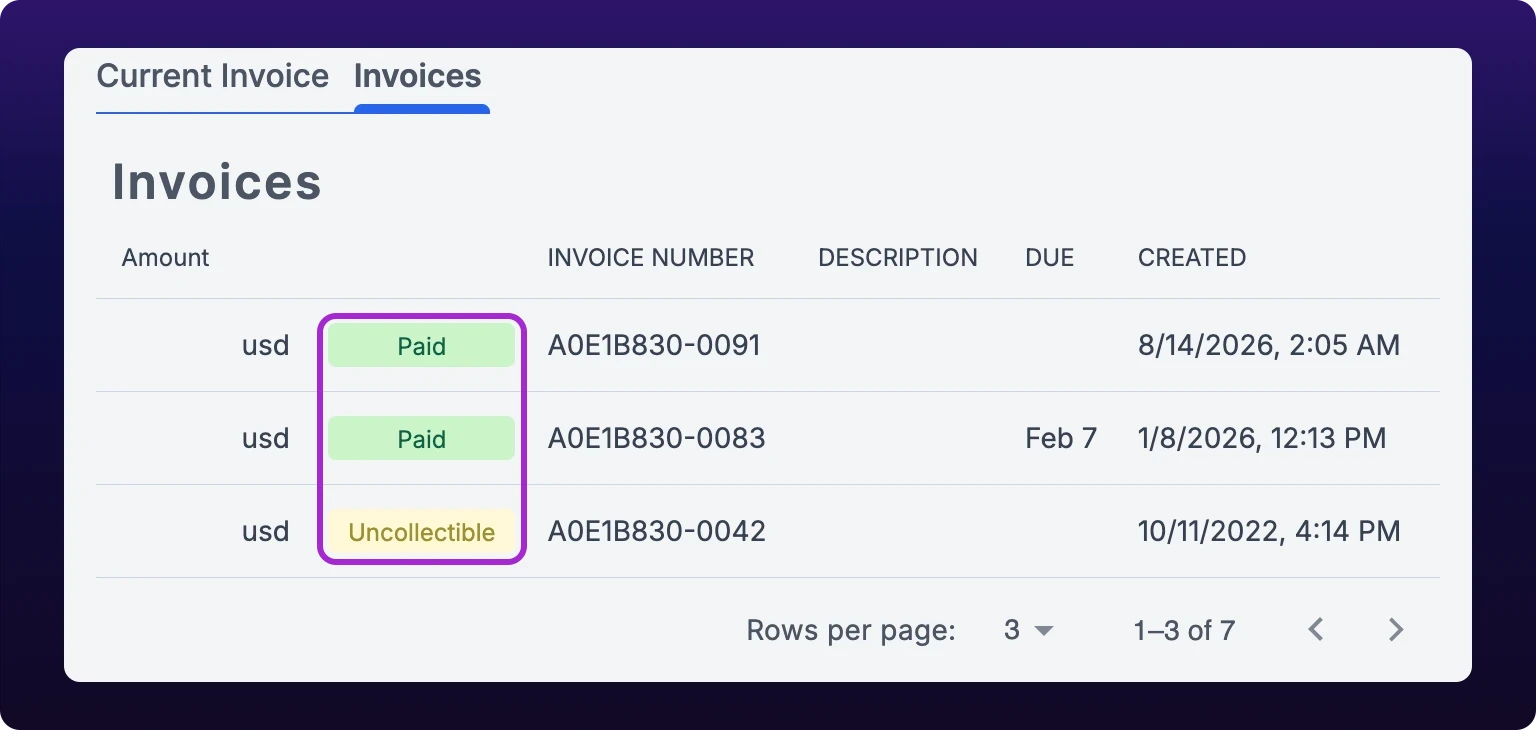 The Invoices tab. Each row shows an amount, a status chip, an invoice number, and its dates. The chips on this account read Paid and Uncollectible.
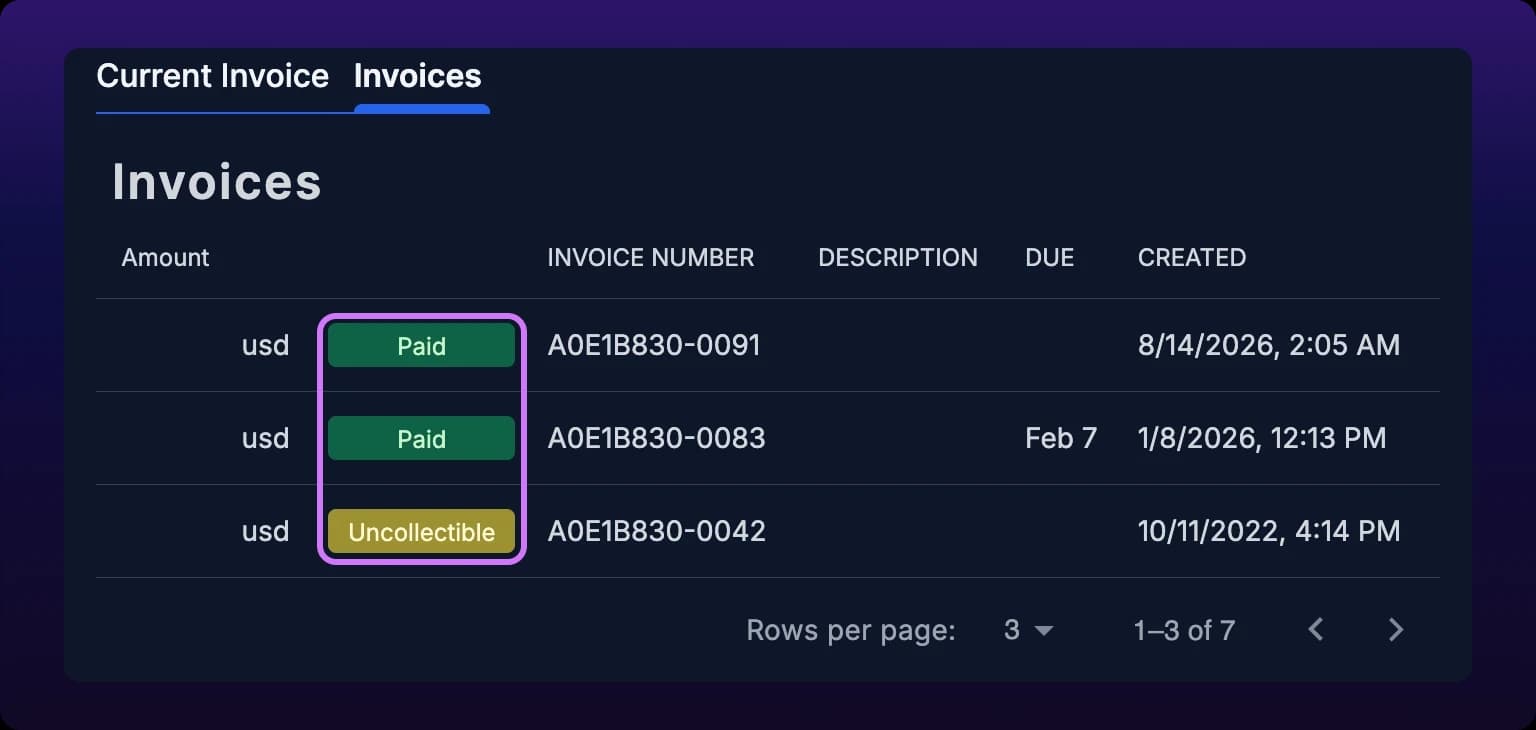
Invoice statuses
| Status | Means | Action available |
|---|---|---|
| Paid | Stripe charged the default card and the charge cleared. | None. Download the PDF for your records. |
| Open | The invoice is issued and unpaid. It is either inside its payment window or past due. | Check the DUE date. If it has passed, confirm the default card is current, then contact support. An open invoice left unpaid is what suspends an organization. |
| Draft | The invoice is not issued yet and its amount can still change. | None. Wait for it to be issued. |
| Void | The invoice was canceled and nothing is owed on it. | None. It stays listed for the record. |
| Uncollectible | IoTFlows has written the invoice off as unpayable. | Contact support before doing anything else. Your organization is at or past suspension. |
Download an invoice PDF
- Open the Invoices tab.
- Select the invoice row.
- In the Summary panel that opens beneath the table, select Invoice PDF.
The PDF opens in a new browser tab. If nothing happens, your browser blocked the pop-up; allow pop-ups for the dashboard and select it again.
The Summary panel repeats the invoice number and its line items with quantities and unit prices, then Subtotal, any discount by coupon name, Total, and Amount due. A discount row appears only when a coupon applied to that invoice, so an invoice without one is not missing a row.
See also
- Restore a suspended organization, if the lockout is already on screen
- Buy IoTFlows hardware, for devices and pricing questions
- Billing questions, including plan changes and refunds
- Roles and permissions, for what else only the Owner can do
- Contact support
How to add an authenticator app to your IoTFlows account, and what changes at sign-in. Two-step authentication sits on your account rather than on an organization, so one enrollment covers every organization you belong to. Enroll from a desktop browser: the Two-step authentication section at the bottom of /settings/user renders inside the mobile app, but its toggle is inert there, so enrollment and turning the setting off are both web-only. Turning the Authentication App toggle on opens Set up authentication app, which shows a QR code to scan into an authenticator app such as 1Password or Google Authenticator; Next then asks for the 6-digit code, and IoTFlows submits it the moment the sixth digit lands. The sign-in challenge itself works on web, iOS and Android. Turning the toggle off takes effect immediately with no code and no confirmation, and there is no self-serve recovery if you lose the authenticator.
What the IoTFlows suspension lockout looks like, and how an Organization Owner clears it. An unpaid account suspends the organization, which puts every member behind an Organization Suspended dialog that has no close button and covers every route except /{organization}/settings/billing. The dialog offers Go to Billing and Contact Support. Only the Owner can open the billing page, so no other role can clear the lockout. Machine data does not collect while an organization is suspended: the sensors keep running, nothing is recorded, and paying the bill does not backfill the gap, which reports show as unknown time. Clear a suspension the day it starts.