

Classify downtime automatically
Rules that put a reason on the stops operators should not have to.
Auto-classification is a rule that assigns a downtime category to a stop without anyone opening the classify modal. Four rules cover the stops every plant sees: short pauses, the edges of a shift, a shift with no production at all, and scheduled breaks. Each rule applies to every machine in the organization, and each carries its own Enabled or Disabled state.
Prerequisites. Organization Owner or Organization Administrator, see Roles and permissions. A shift schedule, see Shifts and timezone: three of the four rules and every break window are measured against it. A category for each rule to assign, see Manage downtime categories.
What the rules do
The rules live under Auto-Downtime Classifications, at the bottom of Organization Settings.
- Click the gear icon at the top right of the header, between the feedback icon and your profile picture. It opens Organization Settings at
/settings/organization, on the Settings tab. - Scroll past the organization details and the device assignment block. Auto-Downtime Classifications is the last panel on the page.
The panel lists each rule with its state and the category it assigns. Click Edit to change either, and Close when you are done. Every change saves as you make it, so there is no Save button.
| Rule | Triggers when | Assigns | Configurable values |
|---|---|---|---|
| Short Downtimes | A machine is down for less than the machine's threshold, 5 minutes by default | The category you pick, or converts the stop to uptime | Enabled, category. The threshold and the convert-to-uptime choice are set per machine |
| Start of Shift | A machine is down as a scheduled shift begins | The category you pick | Enabled, category |
| End of Shift | A machine is down as a scheduled shift ends | The category you pick | Enabled, category |
| Entire Shift | A machine is down for the whole of a scheduled shift | The category you pick | Enabled, category |
| Breaks | A machine is down inside a break window during a scheduled shift | The category on that window | One or more windows, each with a start, an end, a category, and its own enabled flag |
Rules apply to stops as they are recorded from the moment you enable them. To put a reason on stops that already sit in the backlog, use Bulk classify.
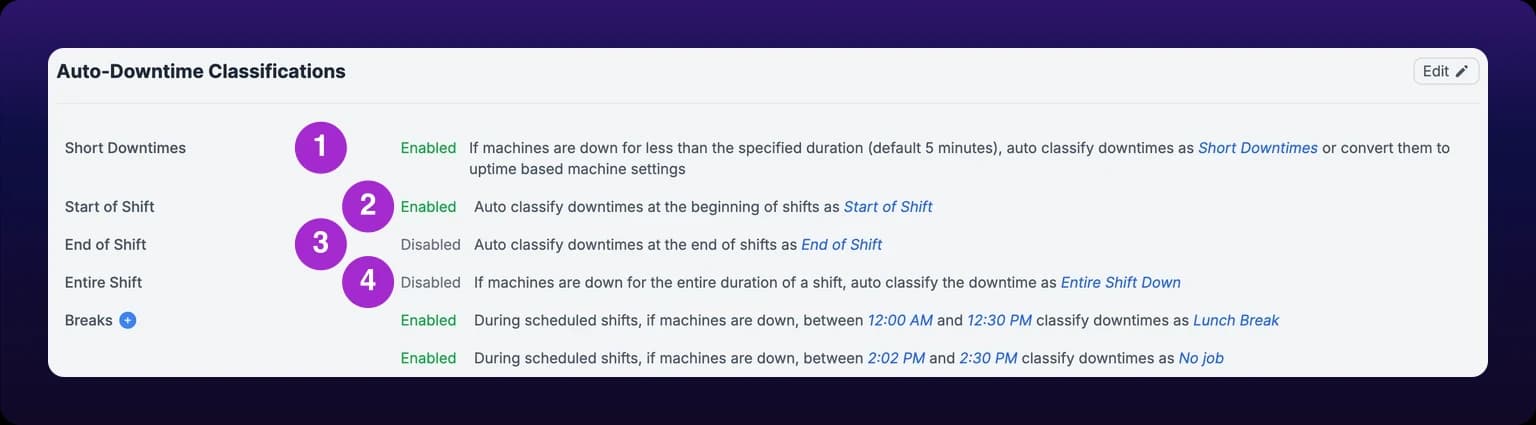 The four automatic classification rules and their current state.
Short downtimes
A short downtime is a stop under a cutoff you set per machine. Tool changes, part loading and indexing all stop a machine for a minute or two without being downtime anybody wants to chase.
This rule has two halves in two places. The organization rule turns it on and names the category it assigns. The cutoff, and whether the stop is classified or converted to uptime instead, are machine settings on the calibration panel, see Handle short stops for SenseAi and Classify short stops automatically for BeamTracker.
- Click Edit on the Auto-Downtime Classifications panel.
- Turn on the Short Downtimes switch. An Enabled toast confirms it.
- Click the category chip and pick the reason to assign, for example
Short Downtime. A Downtime Category Updated toast confirms it.
A machine whose calibration has Treat short downtimes as uptime switched on ignores the category: its short stops become uptime and never reach the classify backlog.
Turn on short downtimes first. It removes the majority of a plant's unclassified rows, and it is the rule least likely to hide something you needed to see.
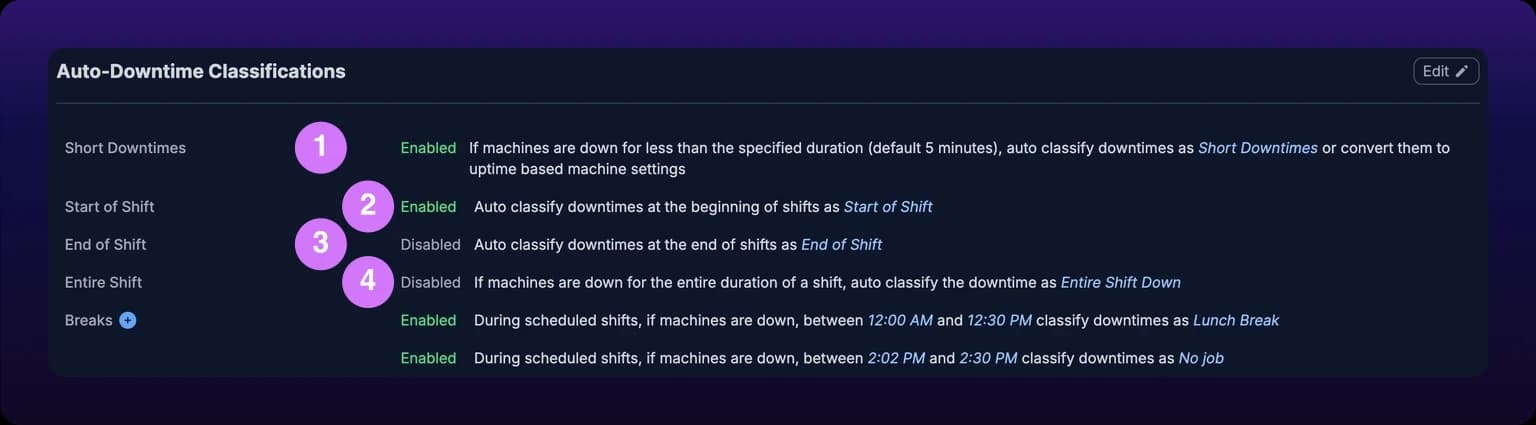
 The short-downtime rule. Turn this one on first.

Start of shift
Machines rarely start cutting the minute a shift begins. Warm-up, the morning meeting and the first setup all read as downtime on the status bar.
Turn on Start of Shift and pick the category to assign, for example Shift start. The rule reads the shift boundary from your schedule, so a stop that runs across the start of a shift is classified from the moment the shift begins.
End of shift
The mirror of the rule above. Cleanup, the last part off the machine and the walk to the clock all read as downtime before the shift ends.
Turn on End of Shift and pick the category to assign, for example Shift end. Together, the two shift-edge rules leave only the stops in the middle of a shift for operators to explain.
Entire shift
A machine that never runs during a scheduled shift, because it had no job, no operator or a fault carried over from the day before, produces one stop the length of the shift.
Turn on Entire Shift and pick the category to assign, for example No job scheduled. The rule matches a stop only when the machine is down for the whole shift, so a machine that runs for one cycle is left for an operator.
Leave Entire Shift off until you trust your shift schedule. If the schedule says a shift ran when the plant was closed, every machine reads as down for the whole of it, and this rule silently classifies a shift of real downtime under whatever category you chose. Turn it on once the shifts on Shifts and timezone match the calendar on the floor.
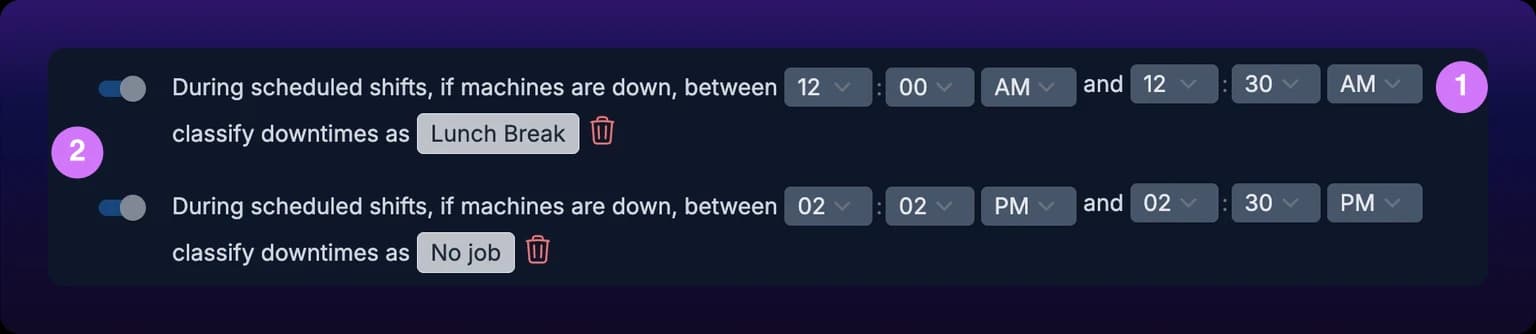
 The entire-shift rule, left off until the shift schedule is trusted.

Scheduled breaks
A break window is a start and end time inside which any stop during a scheduled shift is classified with the category you attach. Lunch is the usual one. A plant with two lunch waves adds two windows.
- Click Edit on the panel, then the + beside Breaks.
- In Add Downtime Break, set the start hour, minute and AM or PM, then the end.
- Click the category chip and pick the reason, for example
Lunch break. - Click Add Break. A Downtime Break Added toast confirms it, and the window appears enabled.
Each window carries its own switch. Turn one off to keep it for later without deleting it. Changing a time saves on the spot with a Start Time Updated or End Time Updated toast. The trash icon deletes the window immediately, with no confirmation, and a Downtime Break Deleted toast follows.
Break window fields
| Field | Values | Notes |
|---|---|---|
| Start time | Hour 01 to 12, minute 00 to 59, AM or PM | Stored to the minute. Read against the organization timezone |
| End time | Hour 01 to 12, minute 00 to 59, AM or PM | Same |
| Category | Any downtime category | Picked from the same list operators use |
| Enabled | On or off | On when the window is created |
A window only fires during a scheduled shift. A stop at 12:15 on a day with no shift is not classified, so a break window never turns weekend silence into Lunch break.
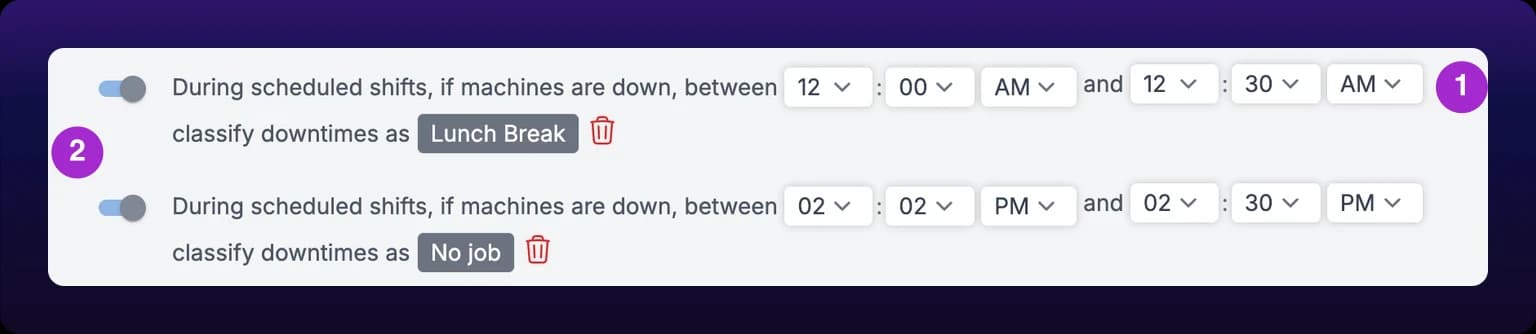 Scheduled break windows. Each carries its own enabled flag.
Turn a rule off
- Click Edit on the Auto-Downtime Classifications panel.
- Turn off the rule's switch. A Disabled toast confirms it.
- Click Close.
The rule stops assigning its category to new stops. Turning a rule off does not remove the category it assigns from the list, and it does not touch a break window: those have their own switches under Scheduled breaks.
What the rules do not do
- They do not reclassify a stop an operator already put a reason on. A rule fills empty slots.
- They do not touch a stop longer than the short cutoff that sits inside a shift. Those wait for an operator, see Classify a downtime event.
- They do not set the short-downtime cutoff. That is a machine setting on the calibration panel, and it defaults to 5 minutes.
- They do not change the numbers. A classified stop is still downtime in Uptime unless the machine converts short stops to uptime.
Rules appear to do nothing? Three of the four rules and every break window are measured against the shift schedule. If a shift-edge stop stays unclassified, or a break window never fires, the organization timezone or the shift times are wrong. Check both on Shifts and timezone before touching the rules.
See also
From the blog
- How to track machine downtime and its causesLet a machine signal record every stop and ask operators only for the reason. A worked shift, rules that name routine stops, and a first-week checklist.
- What IoT machine data adds to an MESAn MES is only as accurate as its machine data. Measured stops and part counts replace typed-in ones, so its downtime and OEE factor split come out right.
- Manual vs automatic OEE tracking in the first weekMachine-reported stops move lost minutes from performance into availability. OEE itself moves only if part counts, ideal cycle times or planned time were off.
Downtime categories are the reason codes operators pick from when they classify a machine stop. Create one under a severity heading, require a note on the reasons that need one, mark it as planned downtime, tag it with a category type, give it a color that carries through to the Downtimes report, rename it, and understand why deleting one unclassifies every stop that ever used it.
Read the Health tab on a SenseAi asset: the health score and its trend, the seven operations metrics including bearing health, the X, Y and Z axes, the FFT spectrum with its harmonic markers and RPM, the spectrogram and 3D view, the 14 metric trend charts and what each one rises with, the timestamp inspector that lines every chart up on one moment, the legacy view for firmware below 5, and how to tell degradation from a noisy baseline.